Jewellery Store Lighting Design: Getting Stones to Read
Jewellery store lighting design decides whether the stock looks like stock. A stone produces no light of its own. Every flash a customer sees is a small, bright source reflected off one facet, arriving at one eye at one angle. Design for that and the case sells. Design for bright and even, and you have paid a lot of money to display grey.
Table of Contents
Why general ambient light kills sparkle
Scintillation needs a point source. The apparent size of the emitter matters more than its lumen output: a wide, soft source spreads its reflection across many facets at once and none of them reads as a flash. A recessed panel flattens every stone under it. A 10 mm optic at the right angle makes the same stone move when the customer moves.
The other half is contrast. The working figure is at least 5:1 between the accented piece and its background, 10:1 or higher on the hero pieces, and you get there by holding the ambient down rather than pushing the accent up. A jewellery salon runs comfortably at 150 to 300 lux general, with the product at 1,500 to 3,000 lux. Let the room drift to 500 lux because someone wanted it welcoming, and you spend the rest of the job chasing the cases.
Have a project like this in mind? Message Kenania directly on WhatsApp.
Chat on WhatsAppBeam angle: wash and accent are two different jobs
A wash is 40 to 60 degrees and its job is architecture. It puts light on plaster, stone and fabric so the room reads as finished. It will never light a stone properly and should not be asked to.
An accent is anything from 10 to 36 degrees, and throw decides where you sit in that band. At a 2.5 to 3 metre throw from ceiling to table case, 10 to 15 degrees keeps the beam on the tray instead of the floor around it. Inside a wall vitrine, where the throw is 400 to 600 mm, 24 to 36 degrees is plenty; anything narrower gives a hot spot on one shoulder of the bust.
The rule that gets broken is one beam per piece, not one beam per case. A single 60 degree flood over six trays covers all six and fires none of them: the source is too wide for any facet to throw a flash back at a standing customer. Even coverage is precisely the wrong target. Put a narrow, aimed beam on one tray and watch the best stock migrate under it. Fixture positions belong on the ceiling plan during space planning, not after the joinery drawings are signed off.
Colour temperature: gold, diamonds and coloured stones want different answers
Yellow gold wants 2700K to 3000K. Take it above 3500K and gold goes grey-green and reads as plated.
Diamonds and white metals want neutral to cool. 4000K is the safe answer; specialists push to 5000K, and some go to 6500K to force the blue-white and mask a faint tint in lower colour grades. Be careful there: a 6500K case in a 3000K room looks like a chiller cabinet, and the piece changes character the moment it leaves it.
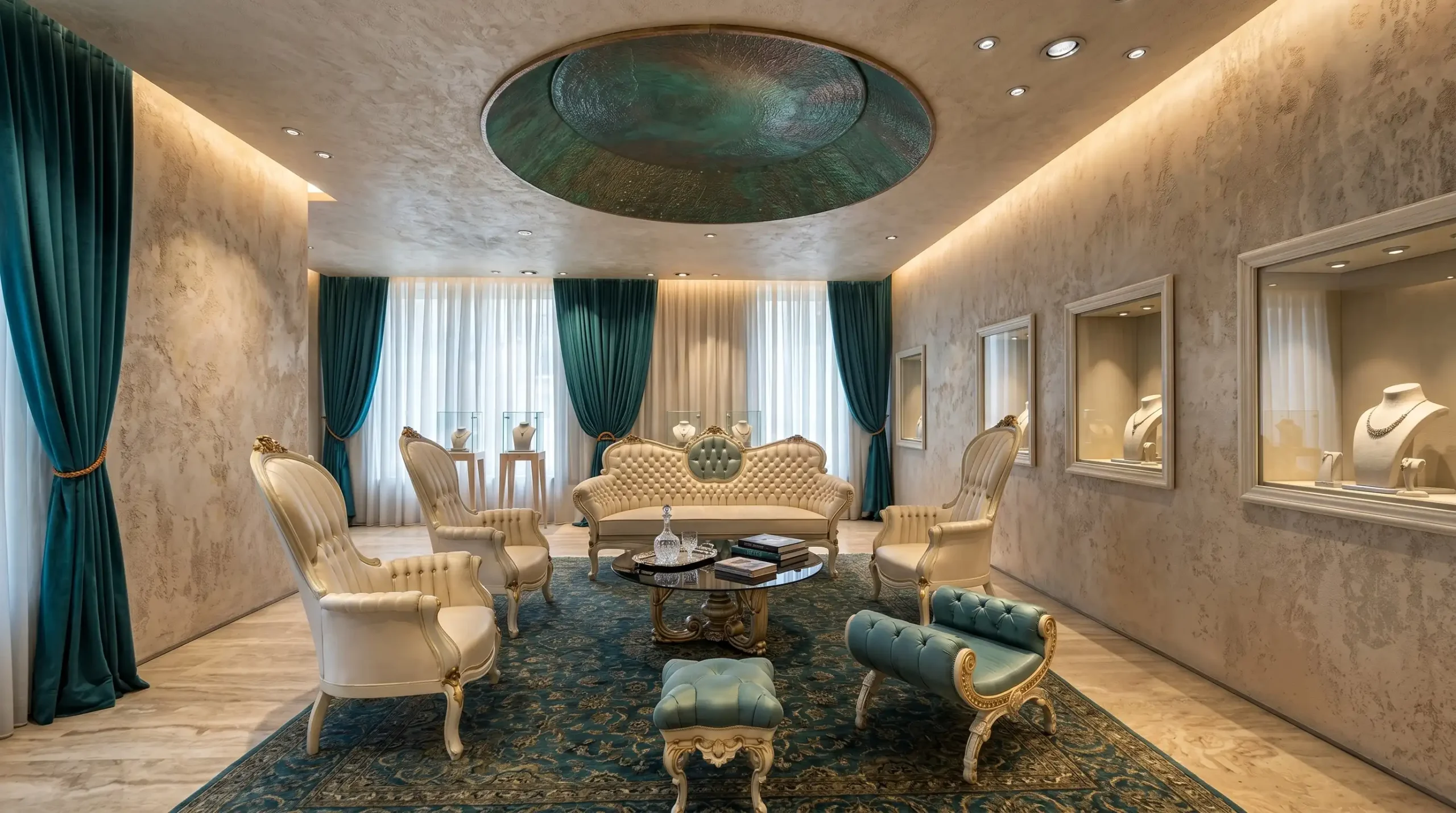
Coloured stones split again. Ruby and spinel need warmth and, more precisely, deep red content in the spectrum. Emerald and jade sit well around 3500K to 4000K. Sapphire holds up cooler. For a mixed store, zone it: room at 3000K, gold cases at 2700K to 3000K, diamond cases at 4000K, and never two colour temperatures in one sightline of a single case. That last fault is the one every visitor notices and nobody can name.
Colour rendering, and why the cheap fitting shows
CRI Ra 90 is the floor and Ra 95 belongs on the hero cases. Ra alone averages pastel test colours and skips the saturated ones, so ask for R9, the deep red value: above 50 is acceptable, above 90 is what separates a ruby from a red-brown lump. Ask for binning too, three-step MacAdam or tighter. Two fittings from different batches in one vitrine is the most visible defect in a finished shop, and it shows up on handover day.
Heat inside the case: where jewellery store lighting design fails out of sight
LEDs still put heat somewhere, and in a sealed vitrine the driver is usually the offender rather than the diode. Remote every driver into a serviceable void outside the case, and keep the fitting body against metal that can shed heat.
What that heat does is not theoretical. Opals dry and craze. Pearls and other organics degrade over months. Setting adhesives soften, glass fogs, and a warm sealed case at chest height makes the customer uncomfortable while a salesperson is trying to close a large sale. The client will call that weak air conditioning. It is the lighting.
Questions about cost, timing or the next step? Ask Kenania on WhatsApp.
Chat on WhatsAppGlare on glass, and the customer’s own reflection
Two separate problems: the fitting reflecting in the glass top, and the customer standing between a bright surface and the vitrine, seeing themselves instead of the necklace.
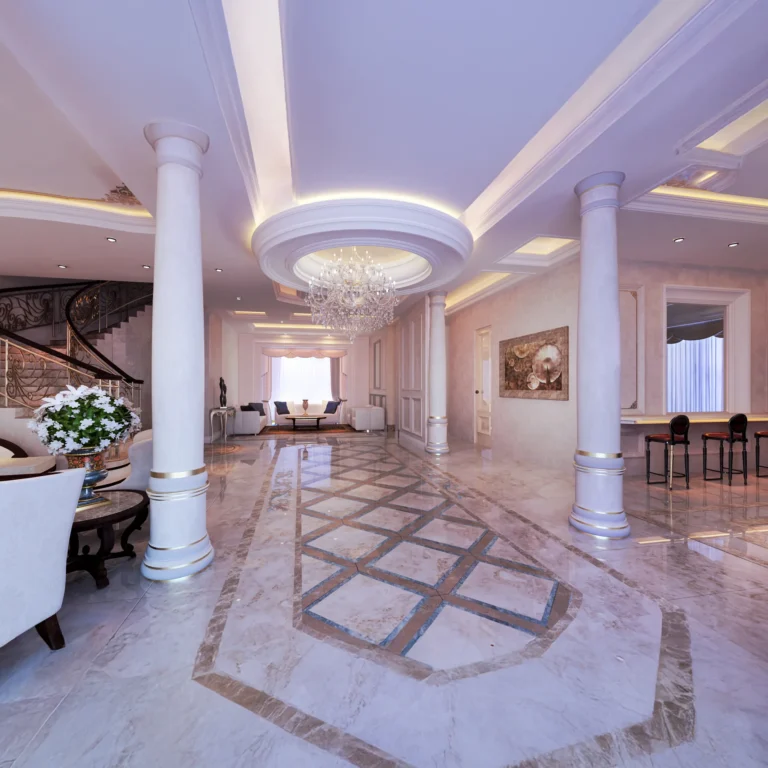
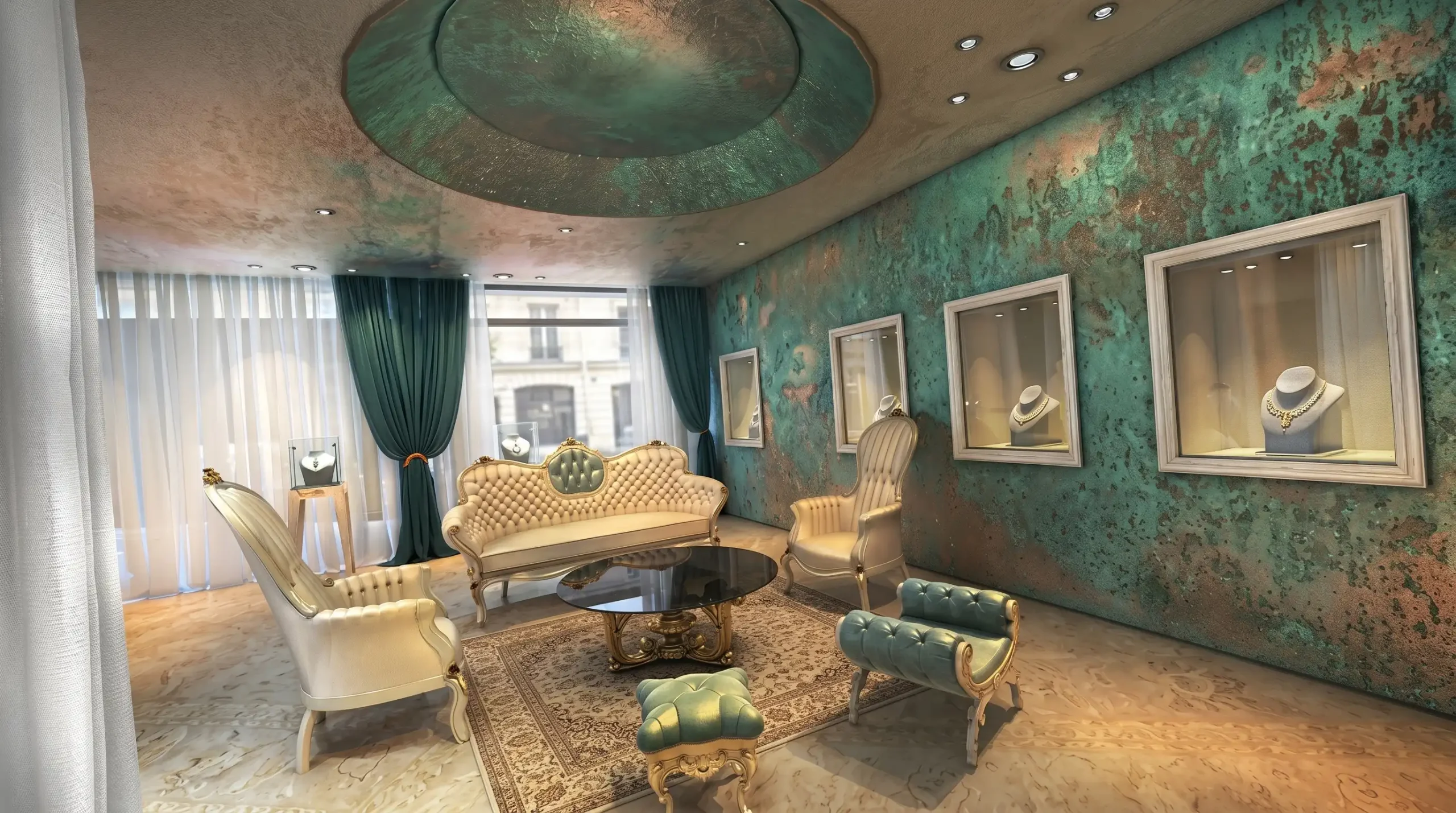
Fix both with geometry before product. Keep ceiling fittings out of the reflected cone of every glass surface. Use deep-recessed fittings, honeycomb louvres and black baffles so no lamp face is visible from standing eye height. Specify low-iron, anti-reflective glass on the hero cases; it is one of the few upgrades in a jewellery fit-out worth the money. And keep the surface behind the customer dark, because a brightly washed wall opposite a vertical vitrine puts a silhouette straight across the piece. That is the same rule that governs the seating in the Royal Bar & Lounge: light the objects and the people, not the walls.
Light the customer’s face, not only the product
The most common failure in a luxury boutique is that the whole budget goes to the merchandise and nobody lights the person wearing it. A customer at the mirror has stopped assessing the stone; they are assessing themselves.
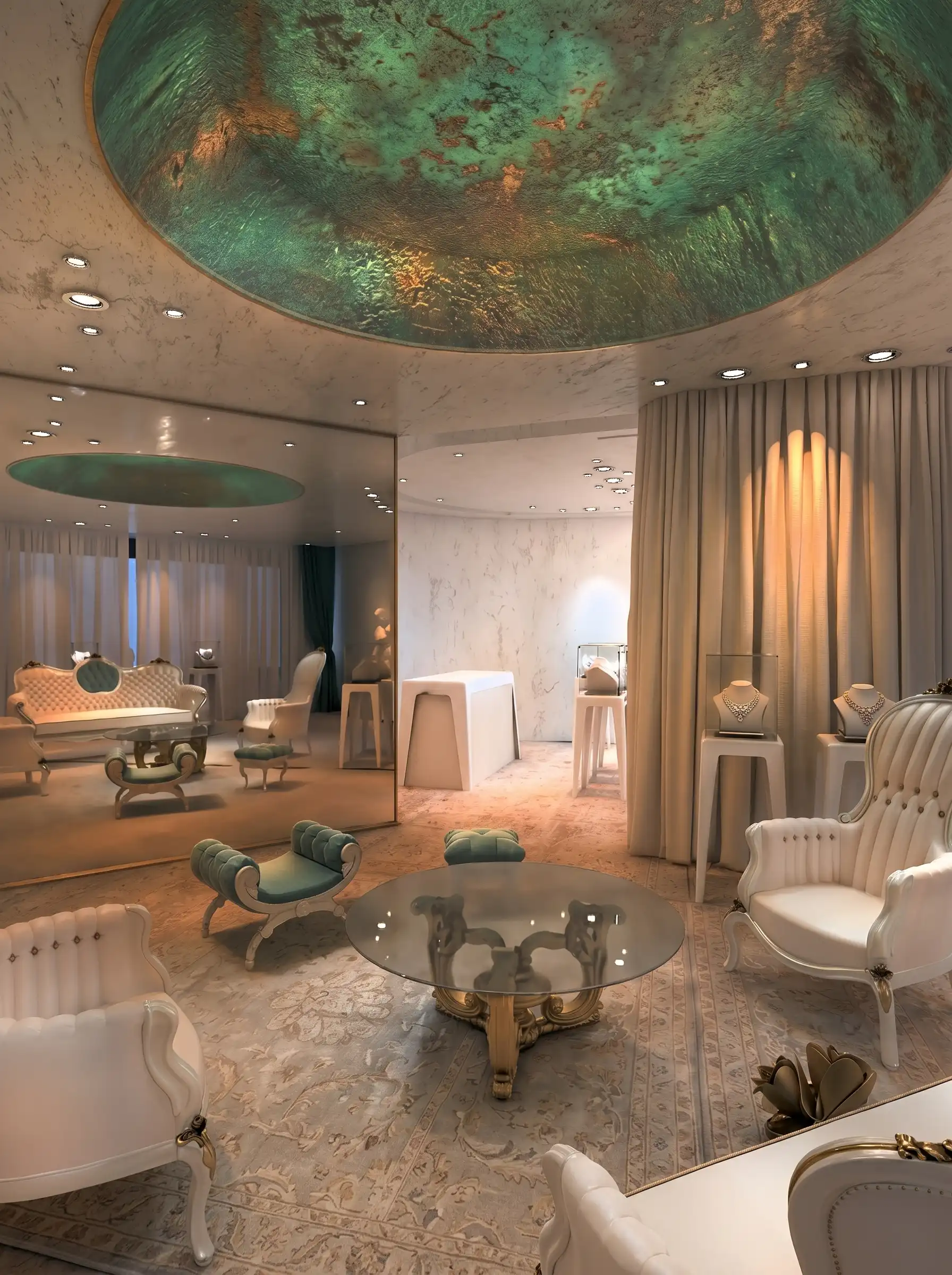
A downlight directly above a mirror gives eye-socket shadow and makes everyone look tired, and the customer will blame the earrings. Put vertical light on the face from two sources at roughly face height flanking the mirror, or a soft vertical element beside the glass. 3000K, CRI 90 or better, on a dimmer. Match the mirror zone to the case the piece came from, or the stone shifts character on the walk over and the sale stalls.
The maintenance access nobody plans
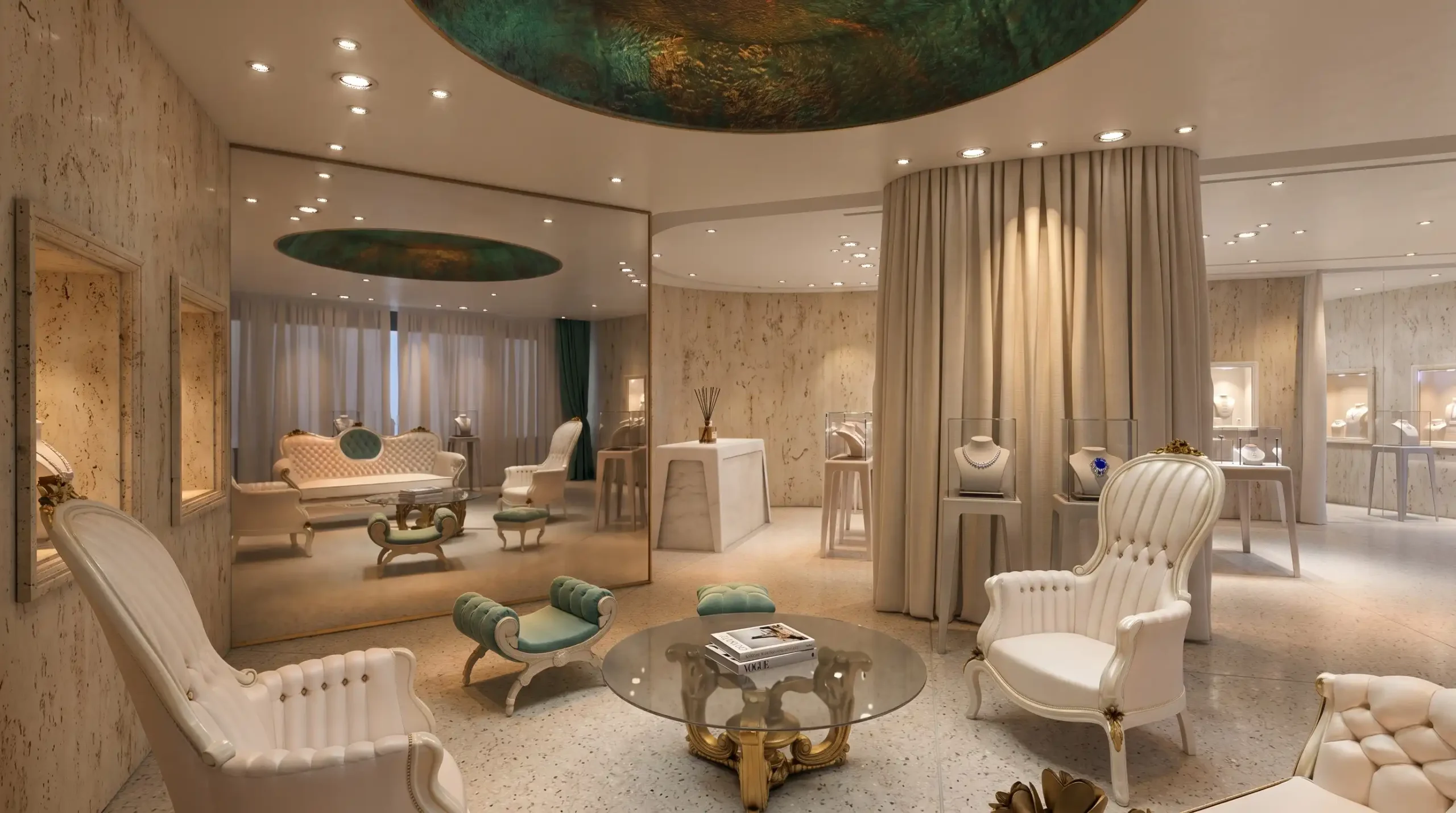
Recessed vitrine frames, mirror-clad joinery, a shop trading seven days a week. A fitting will fail, and by then the joiner has left the country. Ask three questions at design stage. How does a fitting get replaced without dismantling the case? Where does the driver live and who can reach it? Who holds the key?
Then buy spares of every type, from the same bin, with the original order: two years later that product is discontinued and the replacement is a different white. Hand over a lamp schedule at closeout, and put optic cleaning into the operations routine, because dust on a small optic costs real output.
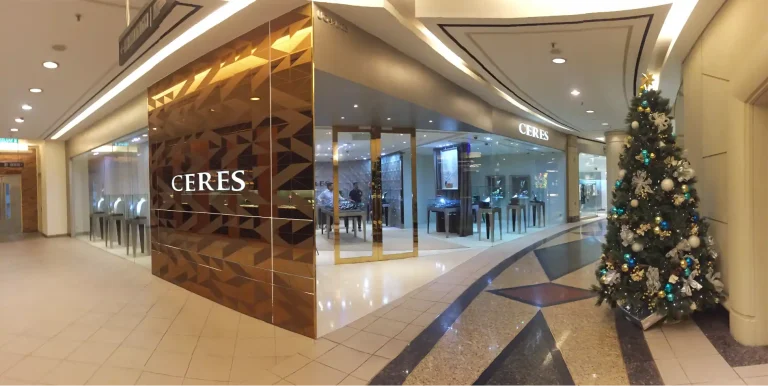
At the Ceres boutique in Starhill Gallery, Kuala Lumpur the wall vitrines are lit from inside their own frames rather than from the ceiling above them.
If you are briefing a boutique, a watch counter or a luxury display area, bring us in before the ceiling is set out. It is interior design work, not a fittings order. Tell us what you are building and we will reply within a day.
More jewellery store lighting design projects and services
More jewellery store lighting design work from Kenania, and the services behind it:
- Jewellery shop interior design in Kuala Lumpur
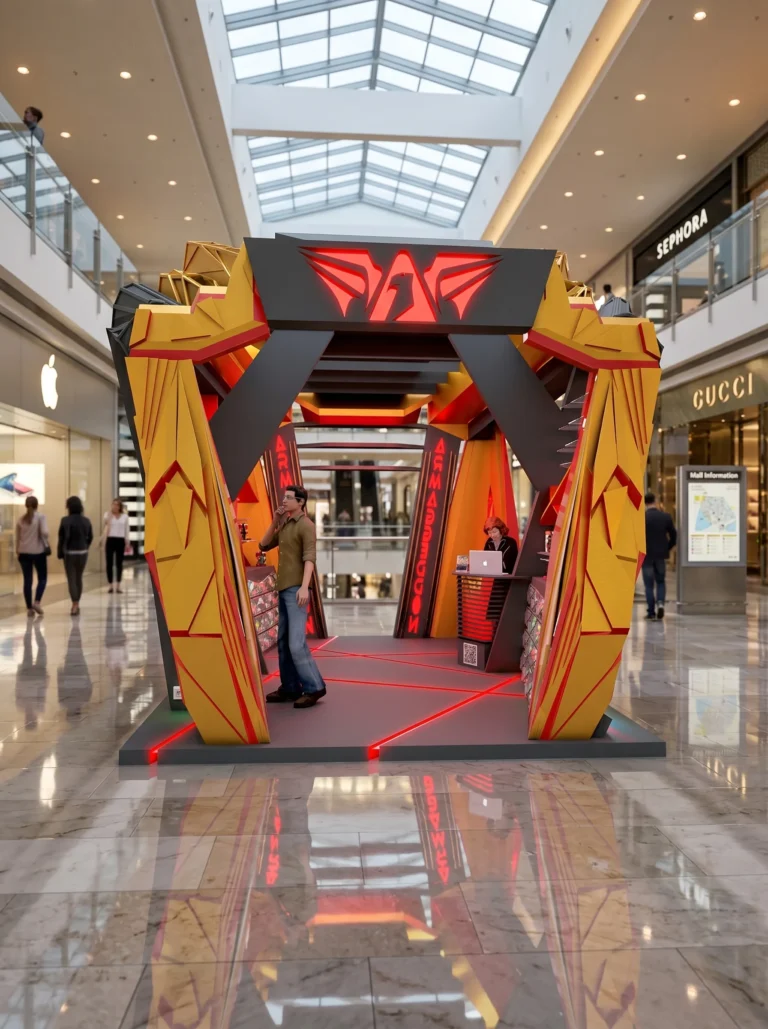
- Kiosk design in Dubai: Ghreiwati Perfumes
- Interior design company in Dubai
Reference: for the standards behind this jewellery store lighting design work, see Illuminating Engineering Society.
Ready to start? Send Kenania a photo, a plan or a short brief on WhatsApp.
Chat on WhatsApp