Machine Learning for Waste Sorting: Why Only 55% of People Sort Correctly
Machine learning for waste sorting sounds futuristic, but the problem it solves is very ordinary: most people put things in the wrong bin.
Table of Contents
The problem: only 55% of people sort their waste
Location: Binko app, FranceYear: 2020
In France, only about 55% of people sort their waste, and even then, the sorting is often done incorrectly. This leads to massive inefficiencies in recycling systems, higher processing costs, and an environmental burden that could be significantly reduced through better practices. At the core of the problem lies one question: how can we help people sort better without adding complexity to their lives?
Interactive prototype
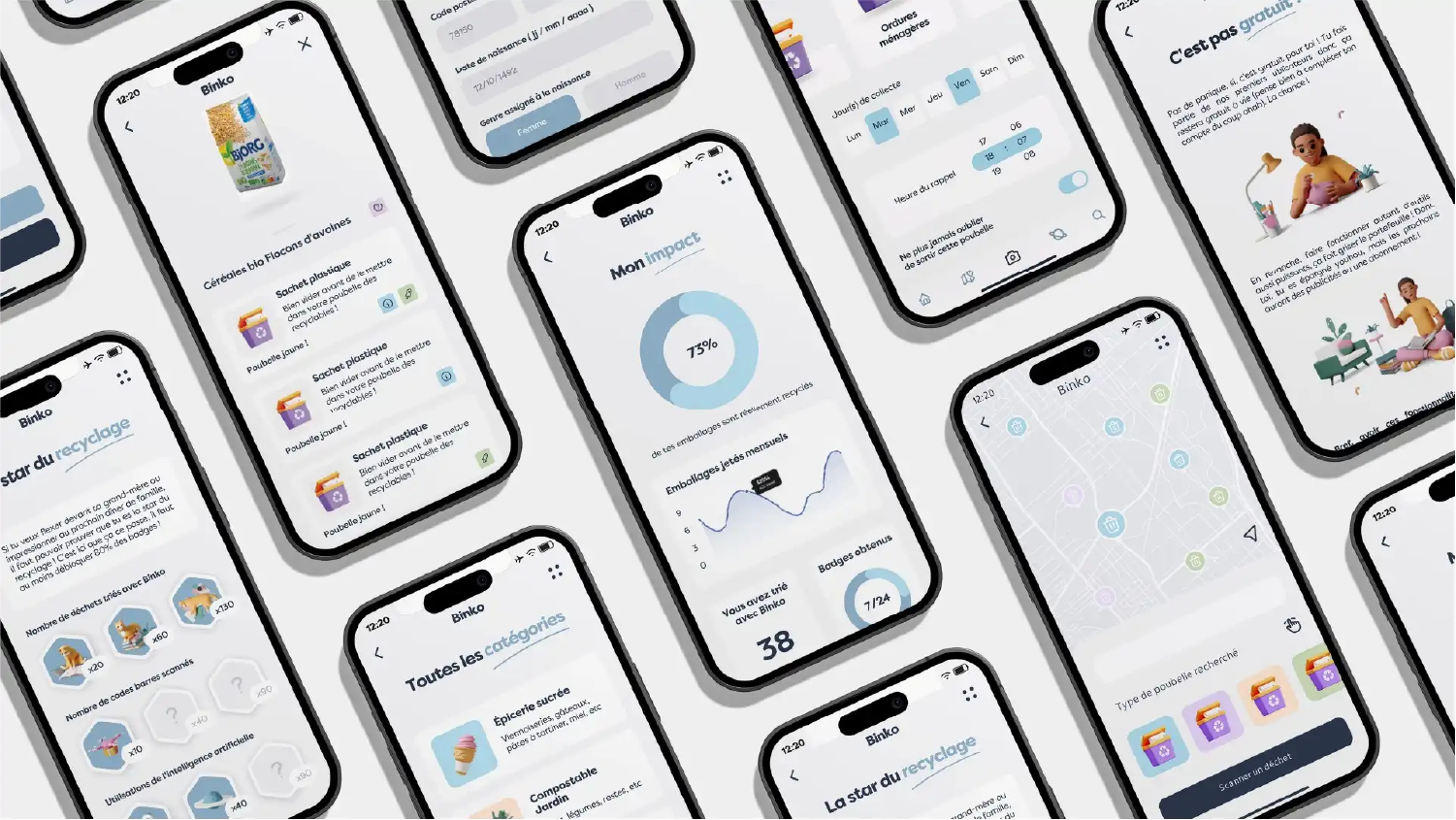
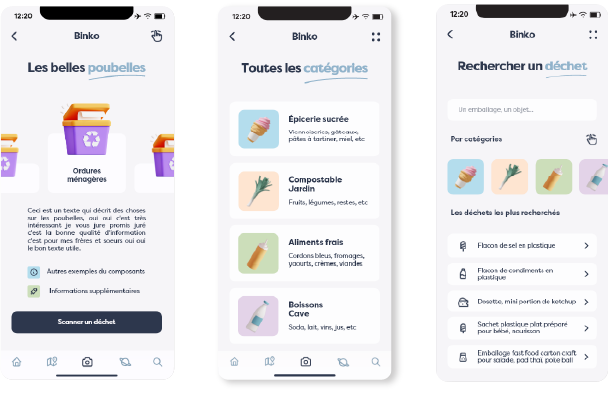
The companion app, from first scan to sorting confirmation. Loads from Adobe XD when you click.
Have a project like this in mind? Message Kenania directly on WhatsApp.
Chat on WhatsAppBuilding a smart product?
We design the interface, the product logic and the brand around it. Tell us what you are building.
🎨 Design Concept & Materials
User’s point of view Machine Learning
In France, only 55% of people sort and often the sorting is not well done. We want to offer everyone a tool that allows them to recognize any waste as quickly as possible and to give them the right gestures to make in order to maximize recycling afterwards by Machine Learning
We are creating a machine / trash can / bin that can recognize automatically any waste, crush it and sort it at source in one of the 6 on-board compartments. So, the waste recognition software must be efficient.
Key Materials Used:
The waste will be separated into parts For exemple a package of cereal we be decompose as :
compostable food residue
cardboard box (outside)
plastic packet
💡 Waste Collection
household garbage
packaging (not everybody)
compostable waste (not everybody)
vegetal waste Machine Learning
bulky items (Once a month)
🛠️ Execution & Implementation Stages
🧠 A Smart Bin That Sorts Waste for You
As a user, imagine a world where sorting waste is no longer your responsibility, but is done instantly and correctly by an intelligent machine. No more wondering, “Is this recyclable?” or “Should this go in compost or landfill?”
We’re building an automated smart trash bin — a device that uses advanced image recognition and material classification algorithms to identify, sort, and process waste on the spot. It’s not just a bin — it’s a full waste management system in one compact product
System highlights
Vision and sensor module — a camera array plus infrared sensing reads material, form and contamination the moment an item is placed in the bin.
Crushing and separation mechanism — multi-material items such as a cereal box are pulled apart, flattened and routed to the right compartment automatically.
Six on-board compartments — plastic, paper and cardboard, compostable food, glass, metal and general waste, each with its own fill sensor.
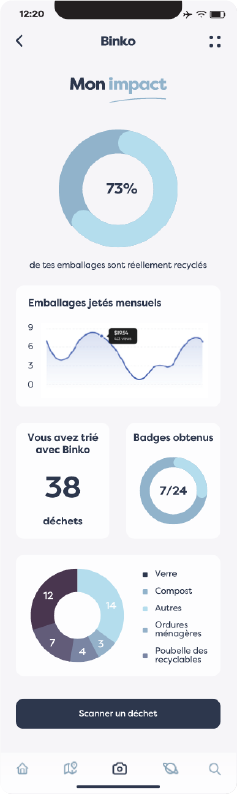
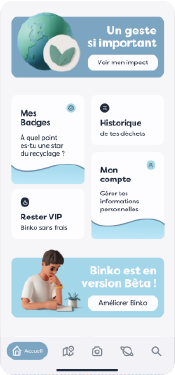
Companion app — a simple interface that confirms every sort, shows household habits over time and suggests small changes that raise the recycling rate.
Model that keeps learning — every confirmed sort feeds the classifier, so recognition improves with use rather than degrading as packaging changes.
🤖 How It Works – Machine Learning at the Core
At the heart of this innovation is a Machine Learning model trained on thousands of waste item types. Users place any item into the bin. Cameras and sensors immediately scan and analyze the object, identifying:
- The type of material (plastic, cardboard, metal, food waste, etc.)
- The form (rigid, soft, liquid, packaging)
- Whether the item contains multiple layers or components (e.g. a cereal box)
Using this real-time data, the bin determines the correct sorting protocol. If the item is multi-material, it can even separate the components using mechanical functions and guide the parts to the appropriate compartment.
🔧 What Makes Our System Unique
- 6 onboard compartments, each designated for a specific type of waste: plastic, paper/cardboard, compostable food, glass, metal, and general waste
- Automated crushing mechanism to reduce waste volume, especially for bulky items like bottles or boxes
- Sensor array (visual + infrared) to detect food residue, organic waste, and contaminated recyclables
- A connected app interface that gives users insights about their waste habits and offers eco-friendly tips

♻️ Real Example: Sorting a Cereal Package
Let’s say you toss a used cereal package into the bin. Our system would:
- Scan the item and detect its components via camera and sensor data
- Separate the contents:
- Any leftover crumbs → directed to the compostable/food waste compartment
- Outer cardboard box → flattened and sorted to the paper/cardboard section
- Inner plastic bag → identified and crushed before being sorted to the plastic compartment
- Confirm sorting and show feedback on the screen or app
All of this is done automatically within seconds — no need for the user to think twice.
🌍 Why This Matters
Incorrect sorting leads to:
- Lower recycling rates
- Cross-contaminated materials
- Increased carbon emissions due to reprocessing
By empowering users with a system that removes the guesswork, we dramatically increase recycling accuracy. Over time, this technology could be implemented in homes, offices, public spaces, and even industrial settings — revolutionizing how we manage waste at the source.
Related product and interface work
- PC builder e-commerce UI/UX: inside the GameX configurator — another data-heavy interface built to fail helpfully
- 5 commercial landscape design tips — Damascus — landscape and site work in a hot, dry climate
Questions about cost, timing or the next step? Ask Kenania on WhatsApp.
Chat on WhatsAppKey takeaways on machine learning for waste sorting
- Machine learning for waste sorting works on a phone camera, so the model has to be small and fast.
- The interface matters as much as the model: machine learning for waste sorting fails if the answer arrives after the bin is closed.
- Local rules change the classes, so machine learning for waste sorting has to be retrained per city.
More machine learning for waste sorting projects and services
More machine learning for waste sorting work from Kenania, and the services behind it. Every machine learning for waste sorting project we publish carries its drawings, so the reasoning behind each machine learning for waste sorting decision can be checked:
Reference: for the standards behind this machine learning for waste sorting work, see US EPA recycling basics.
Planning a machine learning for waste sorting project of your own? Send the plan and a short brief and we will reply with a scoped proposal.
Ready to start? Send Kenania a photo, a plan or a short brief on WhatsApp.
Chat on WhatsApp